Lists of Coach Companies
 |
 |
 |
The Terminator
The Winter Consumer Electronics Show (WCES), convened in Las Vegas, may be smaller in size than the summer show held in Chicago, but from an auto sound perspective it's better: There are more cars, more systems, and more new products. The recent WCES was even more exciting than usual for car audiophiles since both Clarion and Kenwood showed production-line DAT (digital audio tape) players destined for store shelves – they should be there now.
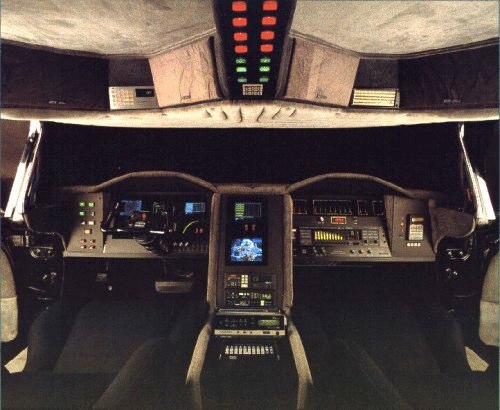
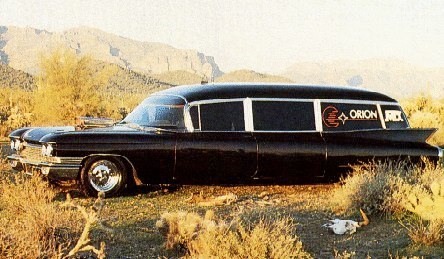
DAT wasn't the whole story, though. It was hard to overlook Wayne Harris's Terminator, a 4-ton 1960 Cadillac Hearse. Harris, an electrical engineer at Orion, has spent over three years working on the Terminator, and estimates that he's put about $60,000 into its audio/video/computer system. The Terminator itself has undergone a facelift. All external hardware has been removed. The side doors are solenoid-controlled and accessed through a key-chain remote control. Switches on the dash can be used to open the doors (from the inside) and to control such functions as wiper and light operation. A Panasonic video camera feeds a Panasonic color screen located in the dash behind the steering wheel for rearview monitoring. The wheel is a Beechcraft King Air, and it has an Escort radar detector built into it.
Also in the dash are the screen for the ETAK navigation system and a text monitor for the on-board Apple II-plus computer. The II-plus turns the system's amps on and off and monitors their temperatures, the status of the electrical system, and oil pressure; its monitor also provides a tachometer display as well as analog and digital speedometer readouts.
The dash console houses a pair of Panasonic 5-inch color monitors; the top one displays graphics from the Apple computer, and the bottom one displays video images from a connected Panasonic VHS Hi-Fi VCR. Beneath the VCR's monitor is the control unit for Alpine's 7375 cassette changer, an Alpine 1341 AM/FM tuner, and the control unit for Alpine's 5900 CD changer.
To the right of the console, Harris installed a logarithmic watt/meter panel with a digital readout; sensitivity is adjustable, range 50 to 1,000 watts. Beneath this panel are a dbx twelve-band real-time analyzer/computer-controlled equalizer, a homemade subsonic synthesizer with four memories (frequencies from 50 to 100 Hz are synthesized down one octave), and a digital delay that feeds MTX speakers installed in the headrests of the Recaro front seats; the delay is adjustable from 4 to 1,064 ms.
To the right of this component cluster is a security panel housing three "independent and redundant" security systems: a Pulsar Intercept 1000, a Pulsar 250, and a no-name paging model Harris "bought from some girl for $80"; the transmitter for the no-name is installed in the headrest of the driver's seat.
Built into the headliner: a trip computer and cruise control; ignition buttons; a keypad for switching on the Apple computer, the amp fans, and the dash lights; and a keyboard for an electric sign that Harris uses at conventions and sound-off competitions.
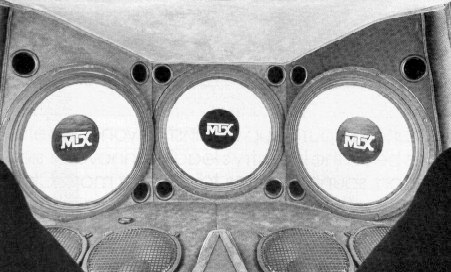
The driver and the front-seat passenger each have their own left/right pair of MTX 1-inch tweeters (crossed over at 5,000 Hz) and 5-inch midranges (crossed over at 97 and 5,000 Hz) installed in the overhead console. In the rear are three 24-inch subwoofers installed in separate, ported chambers, each having a volume of 13 cubic feet, with the enclosures tuned to 18 Hz; the crossover is at 48 Hz with a 30-dB/octave slope, and the 3-dB downpoint is at 22 Hz. Built into the floor are eight MTX Terminator 12-inch woofers installed in separate, ported chambers each having a volume of 1 cubic foot, and these enclosures are tuned to 60 Hz; the crossover is at 340 Hz, also with a 30-dB/octave slope. (Harris says that MTX named the 12-inch subs after his hearse.) The enclosures are made from 1-inch Grade BC plywood; they're internally braced and have beveled joints. Harris sealed the enclosures with wood glue, 2-inch dry-wall screws, and ("for overkill") silicone.
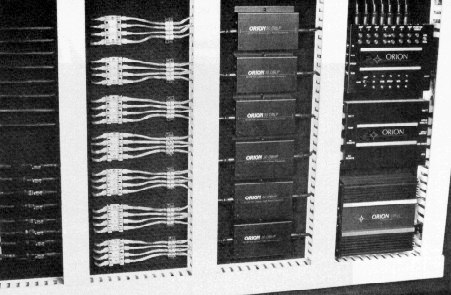
Open the Terminator's rear doors and you'll find a two-sided panel. On one side of the panel are battery cables and bus bars, fuses, six Orion four-way electronic crossovers, a signal-distribution box, and an interface for the Apple computer. The amps are on the flip side: one Orion 240-gx and six Orion 2350-gx's, for a total of 4,280 watts. The amps are protected by three fans, and Harris says that the glass "shroud" over the panel keeps the air circulating over the amps.
The Terminator has the most esoteric and complex mobile electronics system we have seen – and it's also the most fun. Harris is to be commended for advancing the art of installation, as well as for his dedicated pursuit of perfection. This is one hearse we wouldn't mind riding in.
Click to enlarge to view additional Photos and info